
Written by Whitney Herrmann
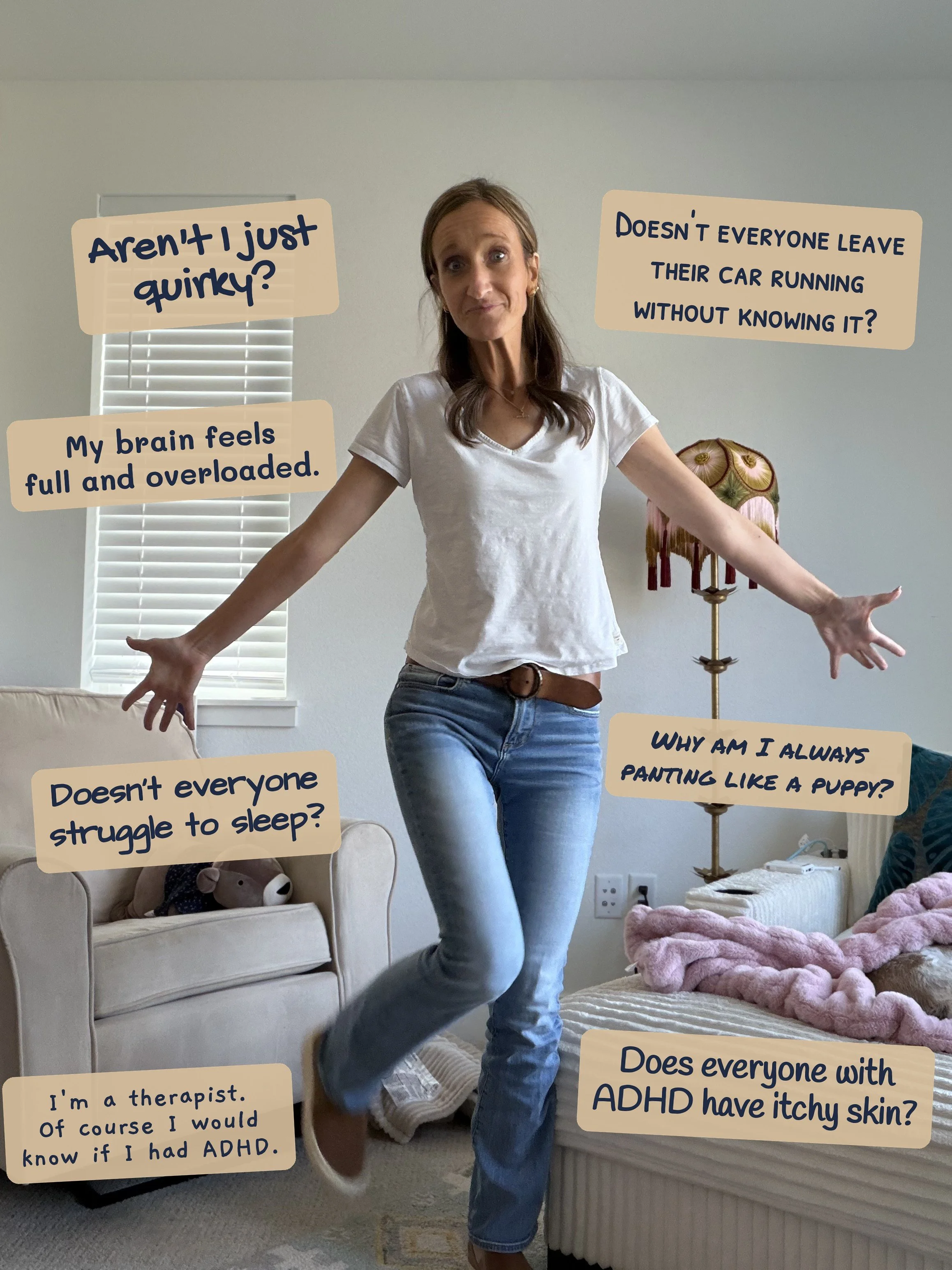
The story of a therapist, a missed diagnosis, and a lunch that changed everything.
Women with ADHD, we owe you an apology.
For ten years of my practice, I truly did not believe I had ADHD.
I was a therapist. I had been to graduate school. Yet the picture of ADHD I carried from my training looked much more like an eight-year-old boy who could not stay in his seat than a grown woman sitting across from you in a therapy office.
I did not see myself in that picture.
My mind moved quickly. I was told it was anxiety. The restlessness I now look at differently was often quiet and repetitive: biting the inside of my cheeks, picking at my skin. Those behaviors were part of my experience, but they did not resemble the obvious movement I associated with hyperactivity.
I accepted the explanation I had been given. For years, it did not occur to me that the explanation might be incomplete.
Apparently, everyone had received the memo
Then one of my best friends—a kindred spirit—was diagnosed with ADHD.
We had a powerful lunch together. Hearing her talk about her diagnosis made me consider a question I had dismissed for years: Could I have it, too?
Afterward, I went home and asked my husband and a dear friend whether they thought I might have ADHD.
I was fully expecting reassurance.
Instead, I was met with faces that seemed to say, “Doesn’t she already know?”
Apparently, there had been a memo. Somehow, the therapist had missed it.
Their expressions were not a diagnosis. But they gave me a reason to stop dismissing the possibility and start asking questions.
There is something profoundly validating about finally having language for a difference you have spent years trying to understand. I could begin to look back at my life with more compassion. My brain worked differently than I had understood, and knowing that gave me somewhere to begin.
Many women with ADHD become remarkably skilled at adapting—masking their struggles and trying to be whatever an environment asks of them. A girl may sit quietly in class while the effort to keep up goes unseen. Outward composure and achievement can hide a substantial need for support. [2]
I think of the women with fast minds and huge hearts who work so hard to meet everyone's expectations that there is little left for themselves. Some arrive at adulthood feeling as though their spirits have been crushed by the effort. That is the human cost I want us to notice.
Burnout took a toll on my own life. Receiving my diagnosis gave me a way to begin understanding that exhaustion and building a path toward wellness. I could start asking what would support me, what I could do differently, and what I needed to stop demanding of myself.
ADHD does not have to leave its chair
ADHD includes two main symptom domains: inattention and hyperactivity-impulsivity. A person can have a predominantly inattentive presentation, a predominantly hyperactive-impulsive presentation, or a combined presentation.
Inattention can mean persistent difficulty organizing, following through, keeping track of belongings, remembering obligations, or sustaining attention. Hyperactivity-impulsivity can involve fidgeting, excessive talking, interrupting, difficulty waiting, or feeling driven to keep moving. In adults, hyperactivity may be experienced as internal restlessness.
A person does not have to be visibly hyperactive to have ADHD. Diagnosis depends on a persistent, impairing pattern across settings, with evidence of symptoms beginning in childhood—not recognition of a few relatable habits. [1]
I wish I had understood earlier how much room there was between a diagnostic description and the stereotype I had absorbed.
How women became easy to miss
Researchers, clinicians, and women themselves have been raising questions about women's ADHD for decades. Yet that understanding has not consistently reached training rooms or clinical practice. There is still a great deal of catching up to do.
A 2020 expert consensus described how less overt symptoms, compensatory strategies, and accompanying conditions can interfere with recognition in girls and women. Anxiety or depression can become the focus while ADHD remains overlooked. These patterns are not exclusive to women, and women can have every ADHD presentation. [2]
For a woman who has spent years holding things together, the question needs to go beyond whether she appears capable. What does it cost her to function? What support does she need? What does her history reveal?
Anxiety may be real and still not explain everything. ADHD and anxiety can coexist. An earlier anxiety diagnosis is not automatically wrong—but it should not close the door to a fuller assessment.
When I speak of the “dark years” of missed ADHD, I mean the years women spent without an explanation that adequately accounted for their lives. Years of trying to correct themselves without understanding what needed support.
I cannot speak for every clinician or every woman's experience. But I can say this: we owe women more curiosity than many of them received.
A new frontier—with important unanswered questions
Some of the most compelling work now asks how ADHD interacts with the rest of a person's body and life. These connections deserve attention without being turned into a single explanation for every symptom.
Hormones. A 2025 systematic review found only 11 eligible studies examining ADHD in relation to female hormonal changes. The findings suggested links between symptoms and hormonal phases, particularly puberty and the menstrual cycle, but the studies were small and varied. Menopause remained an important research gap. An earlier study following 32 young women across a menstrual cycle also found associations between changing hormone levels and next-day ADHD symptoms. [3,4]
That is both promising and sobering. Questions that affect women's daily lives are still being studied with a remarkably limited evidence base. We need better answers about symptom changes across reproductive stages and how to tailor care.
Allergies and immune conditions. Population studies have found associations between ADHD and allergic conditions such as asthma, allergic rhinitis, and eczema. Research has also identified associations with certain autoimmune diseases; a large Norwegian study found that some associations differed by sex. [5,6]
These findings do not establish that ADHD causes allergies or autoimmune disease, or that ADHD itself is an autoimmune condition. They give researchers reasons to investigate shared risks and possible biological pathways.
Irritable bowel syndrome. A 2025 systematic review and meta-analysis found an association between ADHD and IBS. That does not mean ADHD causes IBS, and IBS is different from inflammatory bowel disease. It does suggest that digestive symptoms deserve consideration alongside mental health rather than being dismissed. [7]
Sensory processing. Research in adults has documented differences in sensory sensitivity and sensory seeking or avoidance among people with ADHD. For some, sound, touch, light, or other input may affect daily functioning. Sensory processing differences are not synonymous with ADHD, and they do not automatically establish a separate sensory processing disorder. [8]
Not all of this research is specific to women. Some connections have been investigated for years. The frontier is in understanding what the associations mean, how sex and hormones may influence them, and how that knowledge can improve care.
I want to bring women hope without promising that science has already answered every question. They deserve both compassion and accuracy.
What I want you to hear
If you are reading this and wondering whether your own story deserves another look, you are allowed to ask.
A careful assessment may identify ADHD. It may identify something else, or several things that overlap. You deserve someone willing to listen closely enough to consider those possibilities.
You are also allowed to grieve an explanation that came late. Understanding yourself differently can bring relief and painful questions at the same time.
Bringing hope and empowerment to women who were misunderstood and left behind has now become my life's work. I want to help women ask better questions, understand their needs, and build lives with more support and less shame.
That work includes continuing to question what I think I know.
Protecting my joy, preferably with glitter
When I think about what comes next, I picture my daughter and me with an imaginary toolbox between us.
The label on the lid says: “Things that help us be ourselves.”
I imagine us collecting possibilities: a movement break, something for busy hands, a quieter place to regroup, a way to remember the thing we keep forgetting. Each strategy gets a trial. Does it help? Does it fit? Would we actually use it?
I like to think there is glitter in this toolbox. Probably somewhere glitter was never intended to go.
That is the spirit I want to bring to learning about my own ADHD and finding strategies that support both me and my daughter: curiosity, a little humor, and room to try again.
I am learning to defend and protect my joy with the same intention I bring to my responsibilities. I want my daughter to see that asking for support and enjoying who you are can belong in the same life.
My professional work has grown alongside that personal understanding. I am a Licensed Professional Counselor and founder of The Clarity Group, now specializing in supporting women with ADHD. I have completed more than 58 hours of training through the ADHD Institute, and I continue to build my knowledge as the research develops.
When you sit with me, I want you to feel heard. We can explore your experience carefully and find practical ways to support your wellbeing.
If you recognize yourself in these pages, I would love to welcome you to The Clarity Group. Come see me in my practice, or join me at a future workshop as we continue learning together.
Bring your questions. Bring the parts of your story that have been hard to explain.
There is room for your joy here, too.
Sources
National Institute of Mental Health. ADHD in Adults: 4 Things to Know. https://www.nimh.nih.gov/health/publications/adhd-what-you-need-to-know
Young et al. (2020). Females with ADHD: An expert consensus statement taking a lifespan approach. https://pubmed.ncbi.nlm.nih.gov/32787804/
Osianlis et al. (2025). ADHD and Sex Hormones in Females: A Systematic Review. https://pubmed.ncbi.nlm.nih.gov/40251875/
Roberts et al. (2018). Reproductive steroids and ADHD symptoms across the menstrual cycle. https://pubmed.ncbi.nlm.nih.gov/29197795/
Comorbidity of Allergic and Autoimmune Diseases Among Patients With ADHD. https://pubmed.ncbi.nlm.nih.gov/23400216/
Associations between ADHD and autoimmune diseases are modified by sex: a population-based cross-sectional study (2017). https://pubmed.ncbi.nlm.nih.gov/28983730/
Ng et al. (2025). Association between attention-deficit/hyperactivity disorders and intestinal disorders: A systematic review and Meta-analysis. https://pmc.ncbi.nlm.nih.gov/articles/PMC12130308/
Bijlenga et al. (2017). Atypical sensory profiles as core features of adult ADHD, irrespective of autistic symptoms. https://pubmed.ncbi.nlm.nih.gov/28371743/