
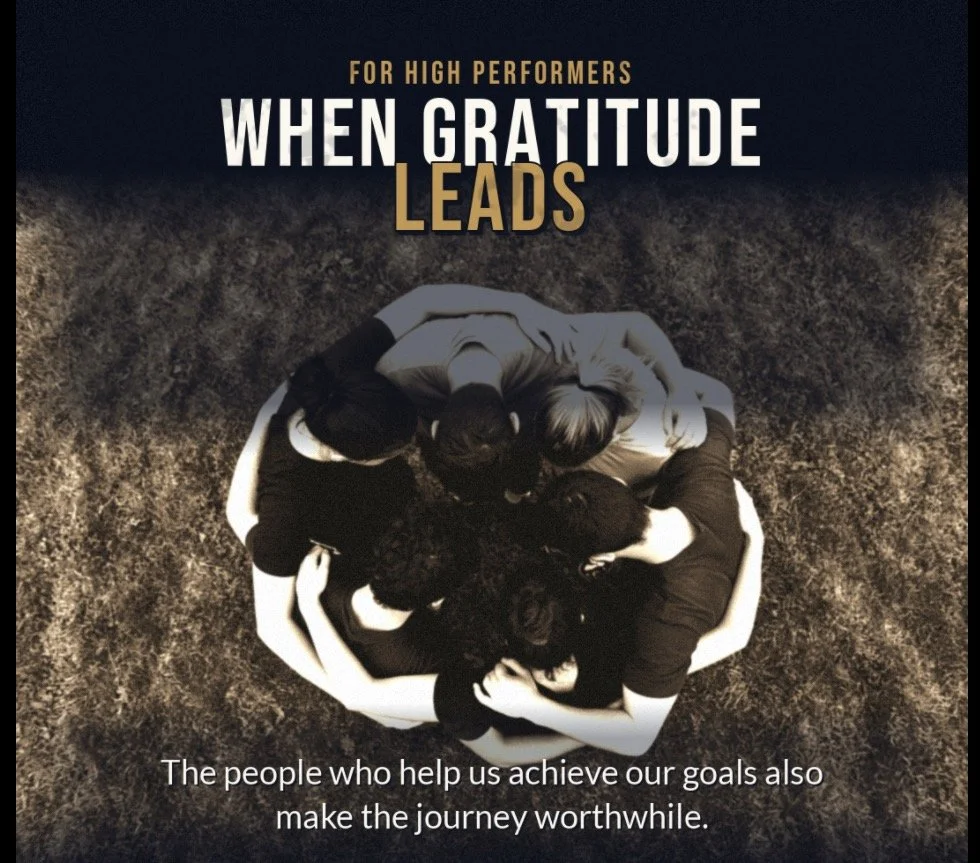
The people who help us achieve our goals also make the journey worthwhile.
By Lindsey Ervin, Counselor, Mental Performance Clinician, and Founder of Human First Athlete Always™
For high performers, gratitude offers a way to stay connected to the human meaning of our pursuits. This season provides an opportunity to pause and recognize the people whose contributions shape our lives, support our goals, and make the journey worthwhile.
As a counselor and mental performance clinician, I work with high performers of all ages. As someone who runs two businesses and sets high expectations for herself, I understand how easily attention moves toward the next responsibility, improvement, or goal. Practicing what I teach means making room to appreciate the relationships that support those pursuits.
In my own work, I am grateful for the teams whose expertise, care, and shared commitment help bring our mission to life. My husband is an important teammate in helping build Human First Athlete Always™, and my family’s encouragement and support are meaningful parts of that foundation. Reflecting on these relationships reminds me that achievement is shaped by many contributions, including those that may never appear in a milestone or measure of success. These people help make our goals possible. They also make the experience of pursuing them more meaningful.
The people around us are part of the story
Angela Duckworth’s new book, Situated: Find the People and Places That Bring Out Your Best, explores how our surroundings shape our behavior and our ability to pursue challenging goals. Her framework includes the influence of peers, mentors, and the cultures we participate in. Personal effort matters, and so do the conditions in which we make that effort. [1]
That idea connects deeply with how I think about mental performance. We often ask people to build confidence, persist, and manage pressure. We also need to ask what their environment makes possible. Who helps them think clearly? Who offers honest feedback with care? Who creates room for learning, questions, and a difficult day? For me, gratitude adds another question: Have I told those people what their presence means?
Being surrounded by wonderful people can help us accomplish more. It can also change the experience of working toward something. Shared effort can become connection. A challenge can become an opportunity to learn together. Progress can become something we get to celebrate with people who understand what it took. The relationships themselves become part of what makes the pursuit worthwhile.
Gratitude deserves a place in our practice
In my work, I frame gratitude as a mental performance skill because it gives us something intentional to practice with our attention. Alongside identifying problems and making adjustments, we can notice what we value and acknowledge the support we receive.
For a high performer, the question “What needs improvement?” may come easily. It is worth making room for “what do I appreciate about this experience?” too. Both questions deserve our attention.
A 2026 study published in Proceedings of the National Academy of Sciences tested six brief gratitude practices with 10,696 participants across 34 countries. [2] Writing and sending a thank-you text showed the largest average well-being impact across the measured outcomes; listing things participants appreciated showed the smallest. The practical application is accessible: put appreciation into words and share it.
Let appreciation become specific
This week, think of someone whose contribution you may have come to count on. A colleague who follows through. A coach who sees the person behind the performance. A friend who checks in. A family member who makes space for your goals. Tell them what you noticed and what it meant to you:
“You made time to listen when I was overwhelmed. I felt supported, and I appreciate you.”
Or: “The care you bring to this work matters to me. I am grateful we get to build something together.”
These are simple messages, but they ask us to pause and recognize something we might otherwise move past. As a leader, I want appreciation to be part of how I show up throughout the year. That includes saying thank you, listening to the people beside me, and considering what they need to do their work well. Gratitude can help me remember that the people contributing to a goal have goals, needs, and lives of their own.
When gratitude leads, appreciation becomes part of how we pursue success, how we lead, and how we care for the people who share the journey.
Sources
Duckworth, A. (2026). Situated: Find the People and Places That Bring Out Your Best. Scribner. Book framework verified against the author’s official overview: https://www.angeladuckworth.com/situated/
Coles, N. A., et al. (2026). A multinational megastudy of the effects of gratitude practices on subjective well-being. Proceedings of the National Academy of Sciences, 123(20), e2537789123. https://doi.org/10.1073/pnas.2537789123